 Facebook
 X
X

IndiAgri Bureau
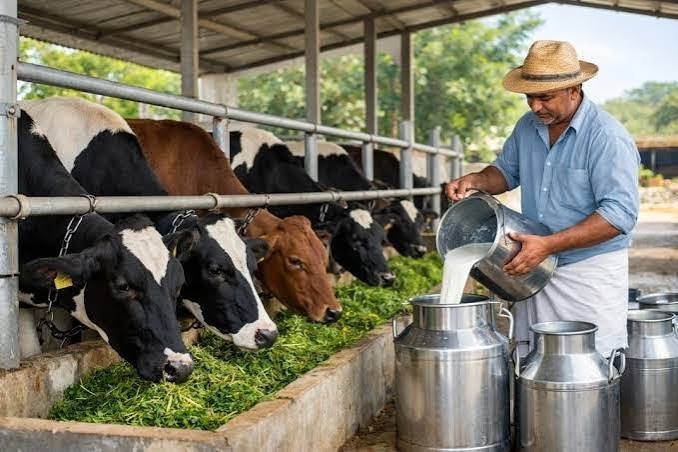
New Delhi: The Central Government on Tuesday said it is continuing to strengthen the country's dairy sector through existing flagship programmes and has no plans to introduce a separate scheme for animal disease prevention, quality animal feed or expansion of artificial insemination facilities.
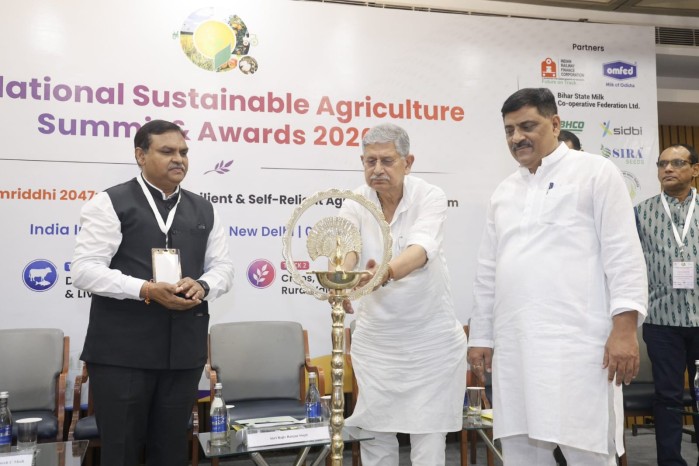
Replying to a starred question in the Lok Sabha, Union Minister for Fisheries, Animal Husbandry and Dairying Rajiv Ranjan Singh (Lalan Singh) said the Department of Animal Husbandry and Dairying is implementing several schemes aimed at increasing milk productivity, improving dairy infrastructure, expanding cooperative networks and enhancing the income of dairy farmers.
The Minister said programmes such as the Rashtriya Gokul Mission, National Programme for Dairy Development, Supporting Dairy Cooperatives and Farmer Producer Organisations, Animal Husbandry Infrastructure Development Fund, National Livestock Mission and Livestock Health and Disease Control Programme are helping improve bovine productivity, expand milk processing infrastructure, ensure better availability of feed and fodder, strengthen dairy cooperatives and provide animal health services across the country. These interventions are also aimed at reducing the cost of milk production and improving returns for milk producers.
Highlighting the progress made under White Revolution 2.0, the government informed Parliament that by June 2026, as many as 36,611 new Dairy Cooperative Societies had been formed while 34,557 existing village-level dairy cooperatives had been strengthened with financial assistance under the National Programme for Dairy Development. During the same period, around 168 lakh litres per day of milk chilling capacity was created and 76,748 milk quality testing devices were distributed. In addition, projects with a combined milk processing and value-addition capacity of 418 lakh litres per day have been approved under the Animal Husbandry Infrastructure Development Fund in both cooperative and private sectors.
On the issue of animal diseases and breeding services, the government clarified that the existing schemes already provide for disease prevention and control, quality animal feed and the expansion of artificial insemination services. Therefore, there is currently no proposal to launch a new scheme covering these areas.
The ministry also placed the latest milk production data before the House. According to the figures, India's milk production increased from 230.58 million tonnes in 2022-23 to 239.30 million tonnes in 2023-24 and further to 247.87 million tonnes in 2024-25. Per capita milk availability also improved during the period, rising from 459 grams per day to 485 grams per day, reflecting continued growth in the country's dairy sector.
The government also submitted state-wise details of financial assistance released under various dairy and livestock development schemes over the past three financial years, including the Rashtriya Gokul Mission, National Programme for Dairy Development, Animal Husbandry Infrastructure Development Fund, Supporting Dairy Cooperatives and Farmer Producer Organisations, Livestock Health and Disease Control Programme and the National Livestock Mission.





.jpeg)

 FAO Sadewa.jpg)
 4.JPG)






.jpg)