Facebook
 Linked In
 Twitter
 YouTube

Navneet Anand & Priya Singh Om
.jpeg)
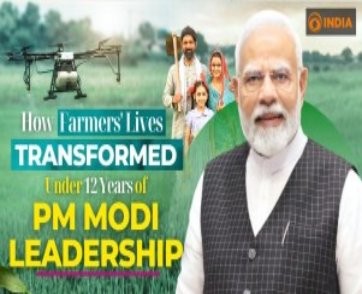
Prime Minister Narendra Modi’s Independence Day address this year carried a message that deserves particular attention from the agriculture community. At its heart was a reaffirmation of the government’s continuing focus on the annadata, but with an important new dimension: the Indian farmer must increasingly see himself not merely as a producer for the domestic market, but as a participant in global agriculture.
This is a welcome and timely evolution in the government’s agricultural vision since 2014. Over the past twelve years, the NDA government has pursued a wide-ranging policy effort covering farm incomes, irrigation, insurance, credit, soil health, markets, infrastructure, technology, food processing and allied sectors. The scale of this intervention is reflected in the numbers. Agriculture and allied GVA has risen from Rs 20.94 lakh crore in 2014-15 to an estimated Rs 52.08 lakh crore in 2025-26, while foodgrain production has risen from 265.05 million tonnes to an estimated 376.56 million tonnes over the same period.
Yet the significance of the latest Independence Day message lies not simply in what has already been achieved. It lies in the direction in which Indian agriculture is now being encouraged to move.
The Prime Minister’s call to farmers and agro-processors to leverage Free Trade Agreements and establish Indian agricultural brands in international markets is perhaps the clearest expression yet of this ambition. India has entered into nine FTAs in recent years, opening access to larger markets for Indian farm and processed food products. The Prime Minister’s message was direct: farmers must move from the farm to the export market, taking with them India’s traditional foods, millets, spices, fruits and flowers and turning these into global brands.
This is an audacious proposition, and precisely the kind of ambition Indian agriculture needs.
For decades, the central challenge of agricultural policy was largely framed around food security, production and protecting farmers from market uncertainties. Those remain essential responsibilities. But India today has a different opportunity. With foodgrain production at record levels, expanding horticulture and allied sectors, rising processing capacity and improving agricultural infrastructure, the next frontier is to capture greater value from what Indian farmers produce.
The policy architecture is already moving in that direction. The Agriculture Infrastructure Fund has supported investments in storage, logistics and processing; e-NAM has expanded digital market integration; 10,000 FPOs have been registered; and food processing schemes are creating capacity for value addition. The latest government data also shows agricultural exports rising from USD 37.29 billion in 2013-14 to USD 51.1 billion in 2024-25, while the share of processed food in agricultural exports has increased from 13.7% to 20.4%.
The Prime Minister’s emphasis on global markets therefore fits into a larger reform journey. The objective is gradually shifting from simply producing more to producing better, processing more, building stronger farmer institutions and connecting the farm gate with consumers in India and abroad.
At the same time, the Independence Day speech was a reminder that competitiveness cannot come at the cost of farmer security. The government continues to absorb a substantial part of the volatility in global fertiliser prices. The Prime Minister pointed out that while a bag of urea costs around Rs 3,000 in the global market, Indian farmers continue to receive it at Rs 300. Similarly, DAP, which he said has reached around Rs 5,000 globally, remains available to farmers at Rs 1,350.
This dual approach is important: protect the farmer from shocks while giving him the confidence and capability to compete in larger markets.
The same balance is visible in other reforms. PM-KISAN has transferred more than Rs 4.47 lakh crore directly to farmers through 23 instalments; crop insurance has covered more than 92 crore farmer applications since 2016-17; KCC has expanded institutional credit; and MSP-based procurement has grown substantially. Alongside these measures, the government has pushed natural farming, soil health, solarisation, climate-resilient agriculture and digital technologies.
The emphasis on chemical-free farming in the Prime Minister’s address is also significant in this context. Global consumers are increasingly demanding traceability, quality and sustainable production. Meeting international standards is not simply an environmental proposition. It is becoming a market-access proposition. If Indian farmers can combine traditional knowledge and natural production systems with modern technology, certification, aggregation, processing and branding, the opportunity for value creation is immense.
But there is a larger idea here. The Indian farmer should no longer be seen only as the beneficiary of agricultural policy. He must increasingly become its economic protagonist.
That means stronger FPOs, better post-harvest infrastructure, reliable cold chains, quality certification, modern food processing, export-oriented clusters, better market intelligence and easier access to finance. It also means building the capabilities required to understand international markets and meet their standards.
The journey from annadata to global agri-enterprise will not happen overnight. Nor will every farmer become an exporter. But farmers can participate in global value chains through FPOs, cooperatives, processors, exporters and organised supply networks. The policy task is to ensure that the value created by this transition flows meaningfully back to the farm.
The NDA government’s agricultural journey since 2014 has already been marked by a decisive expansion of the policy canvas. The Independence Day message suggests that the next phase is about confidence, competitiveness and global ambition.
For Indian agriculture, that is a welcome direction. The farmer who has helped make India food secure can now be empowered to help make India an agricultural powerhouse in global markets. The annadata deserves not only protection and support, but also the opportunity to compete, create brands, capture value and lead India’s next agricultural transformation.



.png)