Facebook
 Linked In
 Twitter
 YouTube

IndiAgri Bureau
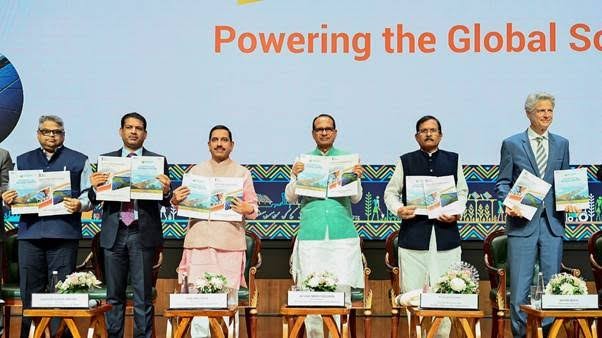
New Delhi: India plans to expand agrivoltaics under the next phase of the PM-KUSUM scheme, aiming to combine solar power generation with crop cultivation and create additional income opportunities for farmers. The announcement was made at the Agrivoltaics World Conference 2026, hosted in India for the first time in the Global South.
Union Minister for New and Renewable Energy Pralhad Joshi announced the proposed expansion at the conference’s inauguration on October 21, alongside Union Agriculture Minister Shivraj Singh Chouhan. The three-day event brings together policymakers, researchers, industry representatives and international partners to discuss the integration of agriculture and solar energy.
Agrivoltaics involves installing solar panels above farmland or within cultivated fields so that agricultural production can continue alongside electricity generation. The approach is intended to help farmers earn from both activities while making more efficient use of land.
Chouhan stressed that agrivoltaic projects must be designed around farmers’ needs, particularly those of small and marginal landholders, who account for more than 85% of India’s farming community. With the average landholding at around 0.96 hectares, he said solar installations should complement farming rather than replace it.
He called for designs that provide adequate height and spacing for farm machinery, allow farmers to change crops and cropping patterns, and incorporate proper drainage and rainwater harvesting. The minister also highlighted the role of Farmer Producer Organisations (FPOs) and opportunities to train rural youth and women in operating, repairing and maintaining equipment.
Joshi said the next phase of PM-KUSUM would support agrivoltaic capacity creation and help address the higher costs of elevated solar structures. Such systems can cost 25–30% more than conventional ground-mounted solar projects, making financial support and commercially viable designs important for wider adoption.
The minister cited a study by The Energy and Resources Institute (TERI), which estimated that around 47.5 million hectares—approximately 30% of India’s 160 million hectares of cropland—could be technically suitable for agrivoltaics. Maharashtra, Rajasthan, Andhra Pradesh, Madhya Pradesh, Karnataka and Uttar Pradesh together account for nearly half of the estimated potential.
The report also outlined a deployment scenario covering 16 million hectares, with estimated annual electricity generation of 12,775 terawatt-hours (TWh). This is a technical estimate rather than a forecast of actual output; practical deployment would depend on land suitability, system design, local conditions and project feasibility.
Agrivoltaic systems could be adapted for horticulture, vegetables, spices, floriculture, fodder cultivation and some livestock activities, depending on the installation and growing conditions. Field studies cited at the conference indicated that certain crops could see yield improvements of 10–20%, while water consumption could fall by around 30% under suitable systems. These benefits are not uniform and would depend on crop type, panel configuration and local conditions.
The conference also highlighted the importance of coordinating agricultural infrastructure with electricity-grid planning. Mapping suitable locations near mandis, warehouses and cold-chain facilities could help identify projects with better access to transport and power infrastructure.
Joshi said India’s installed non-fossil fuel electricity capacity had reached 308.03 GW, accounting for more than 55% of total installed capacity of approximately 560 GW. Decentralised solar capacity stood at 16.3 GW in the previous year, comprising 7.6 GW under PM-KUSUM and 8.7 GW under rooftop solar.
Under PM-KUSUM, the government has supported decentralised solar power plants, standalone solar pumps and the solarisation of existing grid-connected agricultural pumps, including feeder-level solarisation. Santosh Kumar Sarangi, Secretary in the Ministry of New and Renewable Energy, said around 25 lakh pump sets had been solarised under the scheme, benefiting approximately 25 lakh farmers.
Sarangi said the renewable energy and agriculture ministries were working together on the next phase of PM-KUSUM. Developing suitable electricity procurement models involving power distribution companies and state energy departments will be important to support agrivoltaic projects at scale.
The commercial viability of these systems remains a key consideration. Joshi cited assessments indicating potential electricity generation costs of Rs 3.20 - Rs 3.30 per unit under specific assumptions, compared with an average electricity supply cost of around Rs 7 per unit in 2025-26. Actual costs would vary with project design, financing and operating conditions.
Agrivoltaics could also create employment in installation, operation and maintenance. According to the AgriPV Manual of the Center for Study of Science, Technology and Policy, the sector could generate between 1.10 lakh and 3.32 lakh full-time-equivalent jobs.
International experiences were discussed at the conference, including Italy’s funding programme for agrivoltaic projects, Japan’s support for smaller installations and Germany’s emphasis on maintaining agricultural production alongside solar generation. The discussions highlighted the need to adapt technology and policy to local farming conditions rather than apply a single model across regions.
The Global Agrivoltaics Climate-Zone Technical Framework was also launched to help governments, farmers, developers, researchers and financiers assess suitable technologies and develop technical standards for different climate zones.
The conference is scheduled to conclude on October 23. As work continues on the next phase of PM-KUSUM, the key challenge will be to ensure that agrivoltaic systems remain practical for farmers, protect agricultural production and offer reliable economic returns alongside renewable energy generation.




.png)