Facebook
 Linked In
 Twitter
 YouTube

IndiAgri Bureau
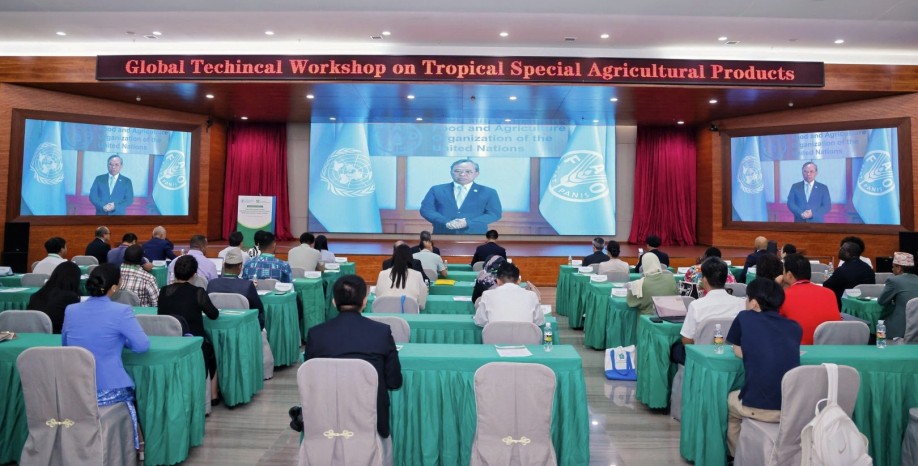
Hainan, China, Bangkok– More than 40 government representatives, technical experts and development partners from tropical countries across Africa, Asia, the Near East, Latin America and the Caribbean are gathering in Hainan, China, from 3 to 8 August for the Food and Agriculture Organization of the United Nations (FAO) Global Technical Workshop on Tropical Special Agricultural Products, held under the auspices of the One Country One Priority Product (OCOP) flagship initiative and the FAO-China South-South Cooperation (SSC) Programme.
The focus of the global workshop is the exploration of how tropical crops can contribute to agrifood systems transformation for enhanced food security and nutrition and sustainable rural development. Co-organized by FAO’s OCOP Secretariat and the Chinese Academy of Tropical Agricultural Sciences (CATAS), the event aims to strengthen technical capacities, promote knowledge exchange and support countries in developing value chains of priority Special Agricultural Products (SAPs).
In a video message delivered at the opening ceremony, Alue Dohong, Assistant Director-General and FAO Regional Representative for Asia and the Pacific said, “collaboration with leading regional science and innovation partners has been instrumental to the successful implementation of OCOP in Asia and the Pacific.”
Lu Sheng, Deputy Director-General of the Department of Agriculture and Rural Affairs of Hainan Province, welcomed participants saying, "Hainan is ready to share its tropical agricultural practices as a model for South‑South cooperation, working together with global partners to explore new pathways for the green development of special agricultural products."
Special Agricultural Products in Tropical Regions
Tropical countries account for 60 of the 94 FAO Members participating in the OCOP Initiative. This highlights the importance of strengthening technical expertise and cooperation to unlock opportunities along agricultural value chains in the tropics. Through this global workshop, countries facing similar challenges and opportunities are provided the platform to exchange experiences and learn from successful practices.
“OCOP is not simply about promoting a product. It is about helping countries transform local potential into sustainable development outcomes. It connects innovation with farmers, knowledge with action, and partnerships with impact,” said Yurdi Yasmi, Director of FAO’s Plant Production and Protection Division (NSP).
Yasmi also underscored the role South-South Cooperation plays in turning knowledge and innovation into practical solutions.
In his opening remarks, Xu Ming, Assistant FAO Representative (Programme) in China, said: “This workshop links dialogue with hands-on learning and country-level follow-up. Its purpose is to build the capacity, knowledge and confidence that participants can take home to strengthen their own farmers and value chains. Through its Programme Cooperation Office, established in Sanya late last year, the FAO Representation in China has strengthened its capacity to support sustained country-to-country technical exchange and translate shared knowledge into practical action.”
Participants in the global workshop come from countries working on a variety of tropical crops, including bananas, cocoa, coffee, mangoes, avocados, cassava, date palms, jackfruit and large cardamom. The participating countries are Bangladesh, Cambodia, Cameroon, Djibouti, Egypt, Indonesia, Iraq, Jordan, Liberia, Malawi, Nepal, Samoa, Solomon Islands, Tanzania, Trinidad and Tobago, and Venezuela.
The programme combines strategic dialogue with practical learning. This includes technical training sessions, field visits and exchanges with Chinese experts. Training will cover sustainable production, processing, post-harvest management, value addition, and marketing.
South-South Cooperation in Action
Hua Yang, Director of FAO’s South-South and Triangular Cooperation Division said, “this workshop offers an important opportunity to share experiences, draw on technical expertise and identify practical solutions for advancing tropical Special Agricultural Products under OCOP. This is exactly what South-South Cooperation is about. It is about sharing practical experiences and proven technologies and adapting them to local conditions. And it is about building long-term partnerships among developing countries to address common challenges together."
The workshop will showcase China’s experience in tropical agriculture through visits to research and innovation facilities, including the National Nanfan Research Institute and the State Key Laboratory of Tropical Crop Breeding, where participants can examine technologies and approaches that can be adapted to their national contexts.
Jiang Changshun, member of the Leadership Group of CATAS, noted that as an FAO-recognized reference centre for tropical agriculture research and training, CATAS is deeply involved in the implementation of the OCOP initiative, providing scientific and technological support for the development of nine tropical Special Agricultural Products.
"We are ready to work with all partners to uphold the vision of 'better production, better nutrition, a better environment and a better life,' and to promote the green transformation of tropical SAP value chains through concrete actions, making OCOP a 'golden key' that benefits local communities and boosts local economies," he said.
A key outcome for participating countries will be identifying areas for priority product expansion, and opportunities for future cooperation, technology transfer and capacity development.


.png)
.jpeg)
.jpg)
.jpg)