Facebook
 Linked In
 Twitter
 YouTube

Priya Singh
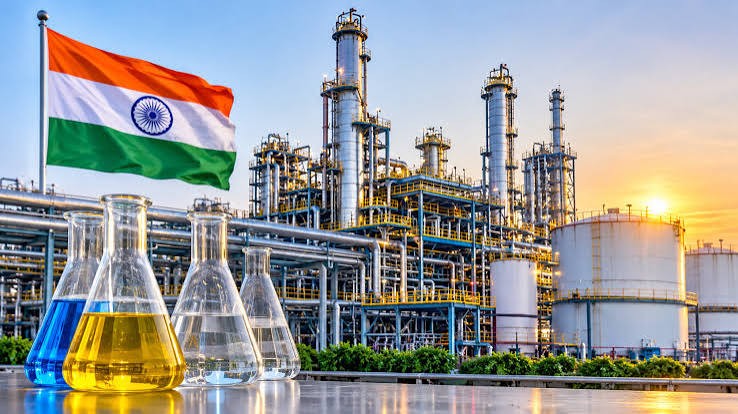
New Delhi: India’s chemicals and petrochemicals industry is positioning itself for a larger role in global manufacturing, backed by rising production, fresh investment, dedicated industrial clusters and expanding research capabilities. Valued at around USD 220 billion, the sector is projected to reach USD 300 billion by 2030 and USD 1 trillion by 2040.
India is currently the world’s sixth-largest producer of chemicals and the fourth-largest in Asia. It is also the second-largest manufacturer and exporter of dyes and the third-largest exporter of agrochemicals globally.
The industry supports a wide range of sectors, including pharmaceuticals, agriculture, textiles, construction, automobiles, electronics and consumer goods. Its manufacturing base comprises approximately 13,000 large-scale units and 4.45 lakh micro, small and medium enterprises (MSMEs).
The expansion of the sector is being supported by investment in manufacturing infrastructure, specialised chemical parks, research and development, technical education and quality standards.
The 14th edition of India Chem was held in Mumbai from October 22 to 24, 2026, under the theme “Advantage Bharat: An Emerging Global Chemicals Hub”.
The three-day event attracted more than 5,000 visitors and brought together industry leaders and businesses through country forums, a CEO Forum and sector-specific roundtables. The exhibition showcased technologies, equipment and investment opportunities. The inaugural India Chem Youth Innovation Challenge also provided a platform for students to present practical, research-based solutions.
The event focused on attracting investment, encouraging international collaboration and exploring opportunities for sustainable growth in the chemicals and petrochemicals industry.
India's chemicals and petrochemicals sector has recorded growth in both production and foreign investment. Foreign direct investment (FDI) inflows reached ₹1,04,895 crore during 2014–2026, more than double the ₹45,240 crore recorded during 2004–2014.
India allows 100% FDI through the automatic route in most chemical sectors, enabling foreign investors to invest without seeking prior government approval.
Production of major chemicals and petrochemicals increased from 45,638 thousand metric tonnes in 2015–16 to 58,617 thousand metric tonnes in 2024–25.
Petroleum, Chemicals and Petrochemicals Investment Regions (PCPIRs) are designed to bring chemical manufacturing units and supporting infrastructure together in integrated industrial clusters.
Each PCPIR covers an area of around 250 sq. km, with approximately 40% earmarked for processing activities. The regions provide common infrastructure and utilities, including road and rail connectivity, ports, water supply, steam generation facilities, sewage disposal plants and Common Effluent Treatment Plants.
India currently has three operational PCPIRs: Dahej in Gujarat, Visakhapatnam–Kakinada in Andhra Pradesh and Paradeep in Odisha.
Together, these regions have attracted ₹3.4 lakh crore in investment, generated 3.7 lakh jobs and facilitated the establishment of more than 2,200 chemical manufacturing units.
The Bharat Audyogik Vikas Yojana Rasayan (BHAVYA Rasayan) Scheme, approved in July 2026, aims to establish three dedicated chemical parks.
Each park will cover at least 8 square kilometres, equivalent to 2,000 acres. The Centre will provide grants of up to ₹1,000 crore per park, subject to a minimum contribution of ₹500 crore from the concerned state government.
The scheme has a total financial outlay of ₹3,030 crore, including ₹3,000 crore for common infrastructure and basic utilities and ₹30 crore for administrative expenditure. It will run for five years, from FY 2026–27 to FY 2030–31.
The proposed parks will offer plug-and-play infrastructure and centralised facilities for effluent treatment, storage, disposal and hazardous waste management. The objective is to improve resource utilisation, reduce logistics costs and support investment in domestic chemical manufacturing.
The Plastic Parks scheme is aimed at strengthening India's downstream plastic processing industry by increasing polymer absorption and domestic value addition.
Under the scheme, the government provides grants of up to 50% of project costs, subject to a maximum of ₹40 crore per project. The remaining cost is met by state governments or their agencies, beneficiary industries and other stakeholders.
Ten Plastic Parks have been approved across the country. Of these, four have achieved 100% infrastructure completion, including three completed during 2025–26.
Apart from supporting investment, production and exports, the parks are also intended to promote waste management and recycling.
Research and technological development are emerging as important areas for the industry's next phase of growth.
The Research, Development and Innovation (RDI) Scheme, launched in November 2025, has a corpus of ₹1 lakh crore to encourage private-sector investment in research and innovation. It provides long-term financing and refinancing on favourable terms for transformative projects.
From October 8, 2026, Advanced Chemicals, Petrochemicals and Material Technologies were included as an additional eligible technology area under the scheme. The move is expected to support indigenous technology development and advanced industrial applications.
The Chemical Promotion and Development Scheme (CPDS) also supports research, studies, surveys, databases, workshops and industry-related knowledge initiatives. It provides grants to organisations, industry associations and other entities for activities that promote the development of the chemicals and petrochemicals sectors.
The chemicals sector's development also has implications for agriculture, particularly in the area of pesticide use and crop protection.
Under CPDS, public sector undertaking HIL (India) Limited has been conducting farmer training programmes since 2016. The Institute of Pesticide Formulation Technology (IPFT) joined the effort in 2022–23.
The programmes focus on the safe and judicious use of pesticides and the adoption of Integrated Pest Management practices. They also seek to minimise pesticide residues in food grains, edible oils, fruits and vegetables.
As of August 2026, more than 250 such programmes had reached over 1 lakh farmers across the country.
The Central Institute of Petrochemicals Engineering & Technology (CIPET) plays a role in developing technical skills and providing research and technology support to the petrochemical and allied industries.
Its network comprises 51 centres, including 19 established since 2014. Three centres are dedicated to plastic waste management.
CIPET has trained nearly 6.72 lakh skilled professionals, including over 5.21 lakh during 2014–24. It also completed 8.53 lakh Technology Support Service assignments during the same period.
The institute's facilities include centres for skilling and technical support, plastic waste management, advanced research in petrochemicals, technology and product simulation, and polymer design and development.
In addition, 18 Centres of Excellence have filed 85 patents, published more than 600 research papers and developed 105 new technologies and products.
As the industry expands, product quality and safe handling of chemicals remain important priorities.
As of August 2026, 37 Quality Control Orders (QCOs) were in force, making specified chemical and petrochemical standards mandatory for domestic manufacturers and importers. The orders require compliance with quality parameters prescribed by the Bureau of Indian Standards (BIS).
Workplace safety is another area receiving attention. A nationwide training programme under the Viksit Bharat@2047 Action Plan is aimed at workers in Major Accident Hazardous (MAH) units. It focuses on the safe handling of hazardous chemicals and reducing workplace risks.
The programme is designed to cover all 2,393 MAH units over five years. Each training programme covers 100 participants from 50 units, with two employees attending from each unit.
As of August 2026, 21 training programmes had been conducted nationwide, with participation from 1,376 industrial units and 2,441 personnel trained.
India's chemicals and petrochemicals industry is working across several fronts to expand its manufacturing base, attract investment and strengthen domestic technological capabilities.
The development of integrated industrial regions, dedicated chemical and plastic parks, research funding and technical institutions is expected to support the sector's next phase of growth.
The challenge will be to translate this expanding infrastructure and investment into greater value addition, stronger domestic capabilities and a more competitive presence in global chemical markets.


.jpeg)