Facebook
 Linked In
 Twitter
 YouTube
Priya Singh

New Delhi: The seventh edition of Gender Samvaad has highlighted the need to strengthen women’s leadership, decision-making and economic agency in rural livelihoods, with more than 6 lakh stakeholders participating in the national dialogue.
Organised by the Deendayal Antyodaya Yojana–National Rural Livelihoods Mission (DAY-NRLM) under the Ministry of Rural Development, in collaboration with the Institute for What Works to Advance Gender Equality (IWWAGE), the event was held on the theme “Participation to Leadership: Enhancing Women’s Agency in Livelihoods.”
The dialogue brought together women from self-help groups (SHGs), State Rural Livelihoods Mission teams, policymakers, gender experts and practitioners to discuss how women can move from participation in livelihood programmes to greater leadership and decision-making roles.
Secretary, Ministry of Rural Development, Rohit Kansal, highlighted the growth of Gender Samvaad since its launch in April 2021. Participation has expanded from around 1,400 people in 2021 to nearly six lakh in September 2025, reflecting the growing reach of the platform.
He also highlighted the scale of the SHG movement, with more than 10 crore women participating, describing it as one of the world’s largest women-led movements.
Kansal pointed to several State-level initiatives aimed at strengthening women’s role in agriculture and rural livelihoods. These include Maharashtra’s Women Farmers’ Empowerment Bill, which recognises women farmers without formal land titles; Odisha’s Bhubaneswar Declaration, which advances women’s land rights and representation in agricultural institutions; and Andhra Pradesh’s RySS natural farming model, which is being driven at scale through women’s SHGs.
He also highlighted the growing number of Lakhpati Didis, with more than 3.46 crore women earning over ₹1 lakh annually.
A key focus of the discussions was the next stage of women’s collective economic institutions, including Cluster Level Federations (CLFs), Producer Groups, Producer Enterprises and Farmer Producer Organisations (FPOs).
Amit Shukla, Joint Secretary-RL, Ministry of Rural Development, said the gender component of DAY-NRLM has evolved from mobilisation to integrating gender considerations into programme design and implementation.
Initiatives such as the Gender Advisory issued in December 2021, Nayi Chetna, the Gender Integration Workshop and the Practice Guide for Gender Integration in Livelihoods have contributed to this approach.
The discussions also stressed the need to strengthen governance, managerial capabilities, financial record-keeping and credit-readiness of women-led collective enterprises.
Joint Secretary Swati Sharma highlighted the ongoing National Campaign on Entrepreneurship-II, being conducted from August 21 to November 21, 2026.
The campaign focuses on enterprise development, value chains, digital platforms and market access for SHG women.
The discussions emphasised that women’s economic agency can be strengthened when SHGs and their federations are supported by skills, financial inclusion, technology, market linkages and asset ownership.
A wider convergence approach involving government departments, research and technical institutions, academia, civil society and development partners was also emphasised.
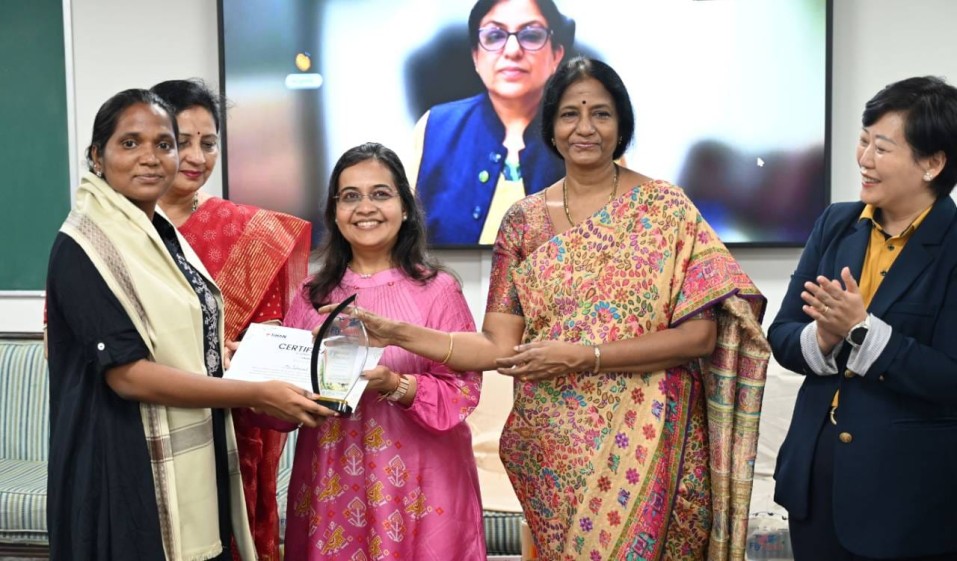
Women leaders from Assam and Maharashtra shared their experiences of moving from SHG participation to entrepreneurship and leadership.
Niharika Bhuyan from Sonitpur, Assam, spoke about her journey from an SHG member to a leader in a women-led Farmer Producer Company (FPC). Her experience highlighted the role of collective action, training and institutional support in strengthening women farmers’ economic participation.
From Akola, Maharashtra, Kirti Tai Deshmukh shared her transition from homemaker to entrepreneur. She attributed her journey to SHG-based training and access to government schemes, which helped build her enterprise and confidence while encouraging other women to pursue entrepreneurship.
Speakers at the dialogue also highlighted issues such as social protection, unpaid care work, resource ownership, access to technology and institutional support as important factors influencing women’s ability to participate and lead in economic activities.
The seventh Gender Samvaad was aligned with the UN International Year of Women Farmers 2026, providing a national platform to recognise the contribution of women farmers and their livelihood institutions to rural livelihoods, food systems and local economies.
Launched in 2021, Gender Samvaad has evolved into a platform for knowledge sharing and policy dialogue, with the latest edition placing greater emphasis on moving women from participation to leadership across rural economic institutions.