Facebook
 Linked In
 Twitter
 YouTube

IndiAgri Bureau
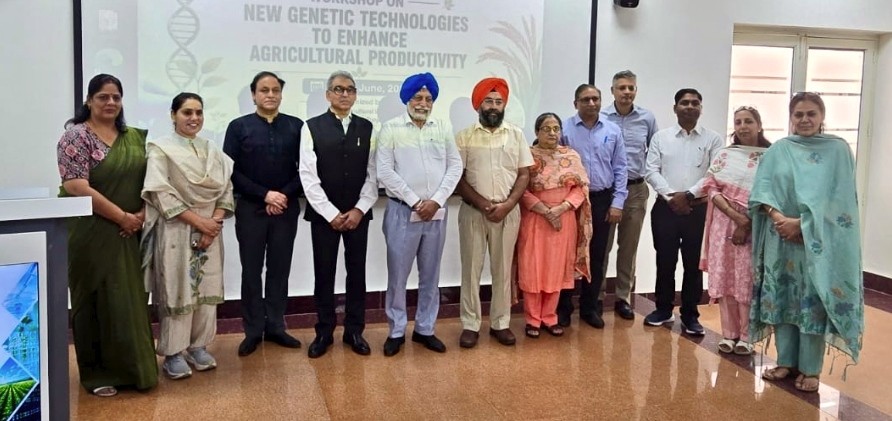
Ludhiana: India must accelerate the adoption of advanced seed and genetic technologies to strengthen food security amid climate change, resource constraints and rising food demand, seed industry experts said on Monday, noting that more than 220 million hectares are already under genetically modified (GM) crops globally, with countries such as the United States, Brazil, Argentina, Canada and the Philippines leveraging biotechnology to boost agricultural productivity.
The call was made at the biotechnology workshop on “New Genetic Technologies to Enhance Agricultural Productivity”, jointly organised by the Punjab Agricultural University (PAU), Ludhiana, and the Federation of Seed Industry of India (FSII). The conference brought together scientists, academicians, policymakers, industry representatives and progressive farmers to deliberate on the role of genetically modified (GM) crops and gene-editing technologies in addressing the emerging challenges facing Indian agriculture.
Dr Paresh Verma, Director General, Federation of Seed Industry of India (FSII) at the conference noted that while countries around the world have embraced biotechnology as an important component of agricultural growth, India continues to grapple with productivity gaps in several major crops even as its population is expected to exceed 1.6 billion by 2050.
"The global scientific evidence generated over the last three decades clearly demonstrates that biotechnology can be a powerful tool for addressing food security challenges. GM crops have helped farmers across the world improve yields, reduce crop losses and enhance resilience against pests and climatic stresses. As India seeks to feed a growing population amidst increasing climate uncertainty, it is important that we evaluate these technologies through a science-based lens and create an enabling ecosystem for innovation. Gene editing represents the next frontier in crop improvement. These technologies enable precise and targeted improvements in crop traits, accelerating the development of varieties that are more productive, resilient and resource-efficient. For a country like India, biotechnology is not merely an option for growth, it is increasingly becoming a strategic necessity,” Dr Verma said.
Dr Verma further emphasized that India possesses world-class scientific capabilities and a strong agricultural research ecosystem, making it well-positioned to emerge as a leader in next-generation agricultural innovation if supported by an enabling regulatory framework.
Echoing these views, Prof Ashwani Pareek, Executive Director, National Agri-Food Biotechnology Institute (NABI), Mohali, highlighted the growing role of advanced genetics in ensuring agricultural resilience and sustainability.
"Agriculture today faces unprecedented challenges arising from climate change, emerging pest pressures and degradation of natural resources. Conventional breeding alone may not be sufficient to address these challenges at the pace required. Modern biotechnologies, including genetic modification and gene editing, provide scientists with additional tools to develop crop varieties that are more resilient, nutritious and productive. The challenge before us is not whether science can deliver solutions, but how quickly we can translate those solutions into benefits for farmers,” Prof Pareek said.
Dr Surinder Sandhu, Head, Department of Plant Breeding & Genetics, Punjab Agricultural University, emphasized that genetically modified (GM) and gene-edited (GE) technologies represent the future pathway for ensuring India's food security, improving farm productivity, and enhancing farmer incomes. “Advanced breeding technologies can play a critical role in reducing India's dependence on imports while strengthening the country's position as a global agricultural producer and exporter. Policy decisions relating to advanced biotechnologies must be guided by science and evidence. There is also a critical need to educate and sensitise farmers about the benefits and safety of modern biotechnologies meanwhile cautioning them against fear-mongering and misinformation that often hinder informed decision-making and the adoption of innovation in agriculture,” said Dr Sandhu.
Dr S S Gosal, Vice-Chancellor, Punjab Agricultural University (PAU), Ludhiana, said, "India's agricultural future will depend on our ability to harness the best of science and innovation. Advanced genetic technologies, including GM crops and gene editing, offer significant opportunities to develop crop varieties that are more productive, resilient to climate stresses, and efficient in the use of natural resources. As a scientific institution, PAU believes that such technologies must be evaluated through rigorous research and evidence-based assessment so that farmers can benefit from innovations that contribute to food security, sustainability and agricultural prosperity."
Experts observed that global food systems are facing increasing pressures from population growth, climate change and geopolitical disruptions, making food security a matter of strategic importance for all nations. In this context, they stressed that science-led agricultural innovation would be indispensable for ensuring sustainable growth in agricultural productivity while preserving natural resources.




.jpeg)


.png)