Facebook
 Linked In
 Twitter
 YouTube

Priya Singh
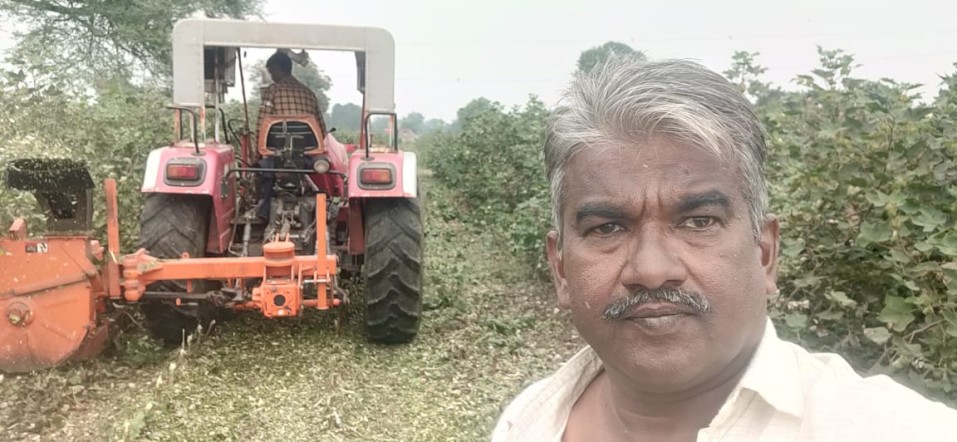
Maharashtra: For Ganesh Nanote, farming has never been just about raising crop yields. It is about understanding the land, experimenting with better practices and ensuring that the soil remains productive for generations to come.
A farmer from Nimbhara village in Maharashtra's Akola district, Nanote's agricultural journey began in 1991, when he was still pursuing his studies. The sudden demise of his father placed the responsibility of managing the family and its agricultural land on his shoulders. As the eldest member of the family, he had to take up farming at an early age.
Initially, he followed the traditional methods practised by his father. However, the relatively low productivity of the light-textured soil on his farm led him to question whether farming could be done differently. That question eventually became the foundation of a journey driven by experimentation and continuous learning.
Today, with nearly 35 years of farming experience, Nanote is known for his work on soil health, crop residue management and sustainable agricultural practices. He is also associated with the Global Farmer Network, through which he has shared farmers' perspectives on agricultural technology and policy.
One of the significant turning points in Nanote's farming experience was the introduction of Bt cotton.
Before its arrival, cotton cultivation was particularly challenging because of the heavy incidence of American bollworm. He recalls that farmers often had to spray pesticides 10 to 12 times during a single crop season, yet yields remained limited to around 3–4 quintals per acre. The crop also occupied the field for nearly 10 months.
According to Nanote, Bt cotton brought a considerable change. It helped control American bollworm, reduced the number of pesticide applications to around three or four and improved cotton productivity. The reduction in spraying also helped save cultivation costs and labour.
For him, the experience demonstrated how agricultural technology, when combined with proper planning and field management, could make a difference.
He has continued experimenting with cotton cultivation, focusing not just on achieving a high yield in one season but on maintaining consistent production year after year.
Regular field inspection is central to his approach. He monitors crop growth, pest incidence and weather forecasts before deciding on farm operations and pesticide applications. He believes that technology alone cannot guarantee results; its effective use depends on the farmer's understanding and timely decisions.
Soil health remains the foundation of Nanote's farming philosophy. His family follows a joint-family system and owns approximately 50 acres of agricultural land. Of this, he cultivates cotton on around 12–20 acres each year.
His focus has been on maintaining the productive capacity of the land rather than pursuing higher output at the expense of soil health.
One of his early experiments began in 1996, when he started incorporating wheat straw into the soil instead of removing it from the field. At the time, keeping fields completely clean was widely considered a sign of good farm management in his area. His approach was different, and some people even made fun of him for leaving crop residues in the field.
Nanote, however, remained convinced that crop residues should be returned to the soil rather than burnt or discarded.
Around 2008–09, as rotavator use became more common in the region, he began incorporating cotton residues into the soil as well. The process involved additional effort in machinery operations, residue management and field preparation, but he continued with the practice.
For approximately 14 years, he has also been incorporating weeds and other organic residues generated on his farm into the soil.
He stopped applying farmyard manure around 12 years ago, partly because declining livestock numbers reduced its availability and purchasing manure from the market became expensive. He says regular incorporation of crop residues has helped maintain organic matter in the soil.
Over time, he observed improvements in soil structure and biological activity, including an increase in earthworm populations. The practice also reduced the expense of purchasing and applying farmyard manure.
For Nanote, residue management is not simply a way to reduce fertiliser or manure costs. It is an effort to improve the soil while making cultivation more economical.
Crop rotation and the efficient use of time between cropping seasons are important elements of Nanote's farm management.
He generally completes the cotton crop cycle in around 160–165 days and follows it with wheat cultivation. The wheat crop takes approximately 115 days, leaving the field with a gap of around 90–100 days before the next Kharif season.
He uses this period for crop residue management and soil preparation, allowing the land to recover while preparing it for the next crop.
Apart from cotton, his Kharif crops include soybean, pigeon pea and other suitable crops. During the Rabi season, he cultivates wheat, chickpea, onion and other crops depending on field conditions.
His effort is to make maximum use of crop residues after every harvest and ensure that organic matter continues to return to the soil.
Nanote believes that the real challenge in agriculture is not merely achieving a high yield in a particular year, but maintaining stable production despite changing weather conditions, irregular rainfall and rising cultivation costs.
He uses his farm experiments to improve soil structure, sustain biological activity, retain moisture and ensure adequate drainage and crop nutrition.
He believes healthy soil can provide farmers with greater resilience against changing climatic conditions.
“Healthy soil means a healthy farmer,” is the principle that guides his approach. For him, this is not just a slogan but a belief shaped by decades of farming experience and field-level experimentation.
Over the years, Nanote's experiments have attracted the attention of farmers and agricultural professionals in the region.
Scientists, officials and students from the agriculture department, agricultural universities and Krishi Vigyan Kendras visit his fields to observe his practices, particularly crop residue management, soil health improvement and sustainable farming.
His experiences have also been featured through All India Radio, Doordarshan, agricultural newspapers, magazines, websites and books. He has received recognition and awards from various organisations, including at the national level, for his contribution to agriculture.
Through social media, he continues to share his experiments and farming experiences with cultivators and others working in the agricultural sector. His work has also brought him into interaction with farmers and agricultural experts from different parts of India and abroad.
Nanote believes that farmers should not limit their learning to their own fields. Sharing successful experiments and practical experiences with others is equally important.
For Nanote, agriculture is both his family's livelihood and an asset that must be protected for future generations. Farming remains his primary source of income, making the long-term productivity of his land especially important.
His approach rests on a few key practices: returning crop residues to the soil, making use of weeds and organic matter, reducing avoidable expenses, maintaining crop rotation and adopting modern technologies with care.
Some of the practices that once attracted criticism have now become reasons for other farmers and agricultural professionals to visit his fields.
He believes that patience, consistency and a scientific approach are essential when trying something new in agriculture. Even after decades of experience, he continues to learn and experiment.
His objective is not simply to produce more, but to achieve consistent yields at lower costs while preserving the natural productivity of the land.
As Nanote puts it, the health of the soil and the economic well-being of farmers are closely connected. Protecting the soil, he believes, is ultimately about protecting the future of farming and the farmers who depend on it.
His farming journey reflects a simple philosophy: when the soil thrives, farming and farmers have a better chance of thriving too.