Facebook
 Linked In
 Twitter
 YouTube

Priya Singh
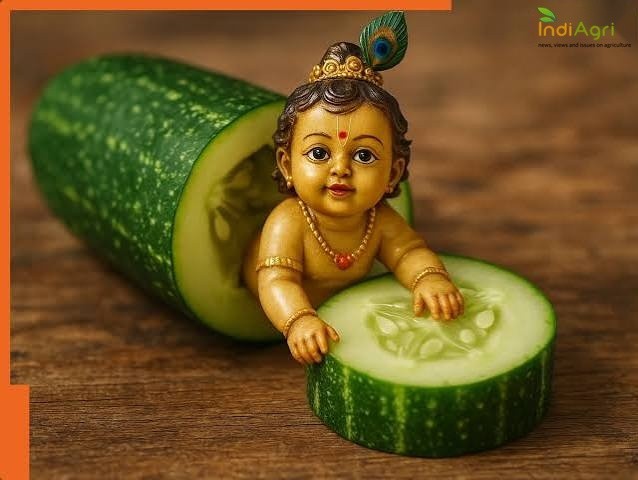
New Delhi: There is a curious agricultural connection to Janmashtami that begins with a humble vegetable: the cucumber. In several traditional observances, a cucumber with its stem attached is associated with the symbolic cutting of the umbilical cord at the birth of Lord Krishna. The stem represents the cord, and cutting it forms part of the ritual before the cucumber is offered as bhog and subsequently distributed as prasad.
The tradition also offers an interesting window into how closely agriculture remains woven into India’s festivals and cultural life. But the humble cucumber has a much larger agricultural story to tell.
India is now the world’s second-largest producer of fruits and vegetables. According to the latest government estimates, horticulture production reached 370.74 million tonnes in 2024-25, up from 354.74 million tonnes in 2023-24. The government’s second advance estimates for 2025-26 project production at 377.78 million tonnes.
Vegetables account for the largest share of this output. In 2024-25, vegetable production was estimated at 217.80 million tonnes, while fruit production stood at 117.65 million tonnes. The continuing expansion of horticulture is significant because it represents more than an increase in agricultural output. It reflects the growing importance of diversification, high-value crops and opportunities beyond conventional field crops.
Cucumber itself has a fascinating commercial dimension. The National Horticulture Board identifies cucumber-growing belts across several parts of the country, including Uttar Pradesh, Bihar, Madhya Pradesh and Maharashtra. Its crop documentation also records cucumber cultivation across different production systems, including protected cultivation.
And then there is the export story. India has emerged as a major global supplier of gherkins, the small cucumbers processed and preserved primarily for international markets. Government data shows that India exported 2,23,515 tonnes of cucumber and gherkins worth USD 223 million in 2020-21, with exports reaching 1,23,846 tonnes worth USD 114 million during April-October 2021 alone. The industry began in Karnataka in the 1990s and subsequently expanded to Tamil Nadu, Andhra Pradesh and Telangana.
So, on Janmashtami, the cucumber can be viewed in two ways: as an integral part of a centuries-old cultural tradition and as a small but telling example of India's evolving horticulture economy. From a sacred offering in homes and temples to a processed product travelling to international markets, it reflects the remarkable range of India's agricultural story.