Facebook
 Linked In
 Twitter
 YouTube

Divyansh Upadhyay
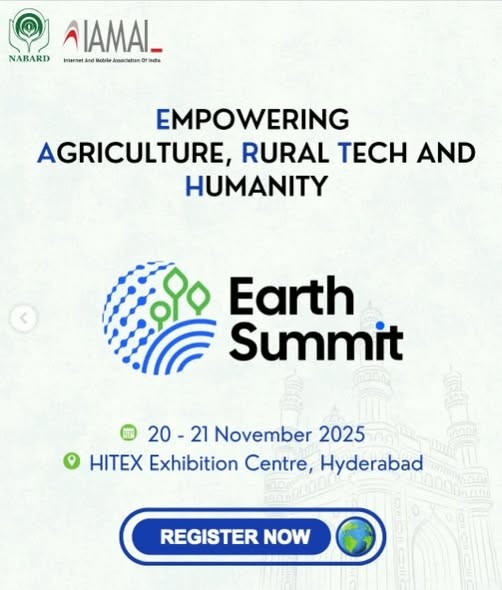
The National Bank for Agriculture and Rural Development (NABARD) together with the Internet and Mobile Association of India (IAMAI) have unveiled the inaugural “Earth Summit 2025-26”, a multi-city conference series designed to accelerate the transformation of rural India through innovation, technology, finance and climate action. The first leg of this initiative will take place in Hyderabad on 20-21 November, followed by additional sessions in Gandhinagar and New Delhi through early 2026.
The summit is being held under the theme “Empowering Rural Innovation for Global Change” and aims to convene policymakers, regulators, industry leaders, investors, start-ups, NGOs and academia. Through this platform, NABARD and IAMAI seek to bridge the gap between rural enterprise, digital infrastructure and sustainable agriculture, creating pathways for rural communities to engage in high-impact innovation and benefit from emerging technologies.
Speaking at the launch, NABARD Chairman Shaji K.V. said that the Earth Summit represents a step toward building a future in which rural innovation drives sustainable global growth. He emphasized that NABARD’s vision has always been anchored in strengthening the rural economy by linking knowledge, technology and finance so that grassroots communities are empowered. The partnership with IAMAI, he said, reflects a belief that inclusive development in villages can become a cornerstone of global transformation. IAMAI President Subho Ray added that the primary idea behind the summit is to turn local innovation into lasting change and build a rural economy that is sustainable, equitable and globally relevant. He noted that India’s success with Digital Public Infrastructure (DPI) offers a strong foundation for such inclusive innovation to scale across geographies.
The Earth Summit will not only feature keynote addresses and panel discussions but also include hackathons, start-up-investor connect programmes, exhibitions and product-showcase areas offering rural innovators a chance to display and scale their solutions. The Hyderabad edition will be hosted at the HITEX Exhibition Centre, with more than 10,000 delegates, 500+ speakers and over 250 exhibitors expected across its three locations.
For rural India, the timing of this initiative is significant. As agriculture contends with rising inputs, climate variability and fragmented markets, the Earth Summit promises to inject fresh impetus into the ecosystem of rural innovation. By combining digitalisation, venture-funding, climate-smart technologies and institutional policy support, NABARD and IAMAI are attempting to accelerate the path from idea to impact in rural landscapes.
The three-city series also signals a strategic move to decentralise innovation platforms, bringing focus to regional centres and recognising that rural solutions must be context-sensitive, locally led and scalable. The involvement of states such as Telangana and Gujarat in hosting the events reflects the insistence that rural transformation must align with state-level ecosystems and priorities.
Ultimately, the success of the Earth Summit will depend on action post-conference: how many innovations move from prototype to deployment, how many farmers benefit, how investors engage, and how policy frameworks adapt. But as a starting point, the launch of this ambitious platform marks a positive moment for rural development in India and reflects a growing conviction that the next frontier of growth lies in empowering the countryside.