Facebook
 Linked In
 Twitter
 YouTube

Priya Singh
Nalgonda, Telangana: A new generation of Indian farmers is increasingly turning to drones, precision agriculture and digital advisory tools to tackle rising farm labour costs, erratic weather and growing pressure on farm incomes. But high technology costs, data concerns and limited suitability for small farms continue to restrict wider adoption.
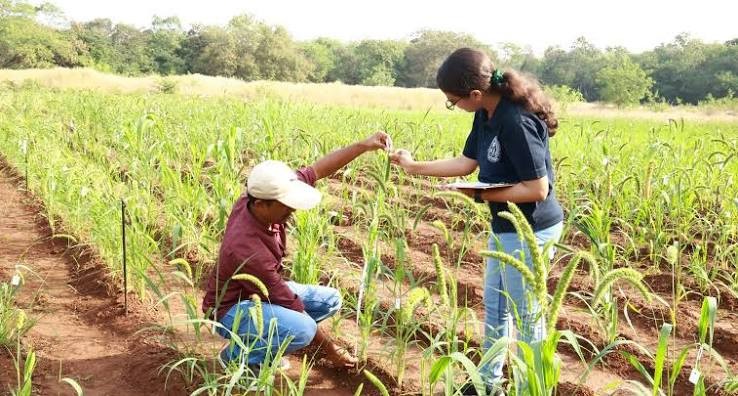
The trend is particularly visible among younger farmers in Telangana’s Nalgonda district, where university students from farming families are exploring agricultural drones not only for use on their own fields but also as a potential rural business opportunity.
A group of students recently tested an agricultural drone designed for pesticide spraying and is considering pooling resources to purchase one. The group could charge farmers around Rs 400-500 per acre for spraying services.
For 21-year-old farmer Shiva Reddy, who comes from a family owning 21 acres, the technology offers both a way to reduce labour dependence and an additional source of income. Drone-based spraying services, he estimates, could potentially generate up to Rs 10 lakh annually.
India is expanding the use of digital technologies across agriculture as farmers face increasingly unpredictable weather, rising input costs and labour shortages.
Drones can help reduce the time required for pesticide application and potentially cut chemical wastage. Precision agriculture technologies use field-level data, sensors, satellite imagery and predictive tools to support decisions related to irrigation, fertiliser application and crop management.
The government's Digital Agriculture Mission, launched in 2024, has also accelerated the development of digital infrastructure for agriculture.
Under the initiative, platforms such as AgriStack are being developed to integrate farmer, land and crop information. The Krishi Decision Support System uses soil, satellite and weather data to generate information including yield estimates and assessments related to drought and flooding.
Digital tools are also being explored to simplify access to agricultural inputs and government services.
The growing use of technology is creating a generational divide within farming communities, with younger farmers generally more comfortable using smartphones, digital platforms and new machinery.
For many older farmers, however, even basic digital processes can be difficult.
In Nalgonda, 65-year-old farmer Muthyala Sathaiya said he needed help from younger people in his village to register on an online fertiliser platform and obtain a one-time password.
Such experiences have created a new role for younger farmers, who are increasingly helping older members of their communities navigate digital agriculture services.
This could make technology adoption a shared generational process rather than simply a replacement of traditional farming practices.
Despite the promise of agri-tech, experts caution that access remains uneven.
Agricultural robots, drones and sensors are already being used on larger farms, but their high upfront costs make them difficult to adopt for small and marginal farmers.
A basic agricultural spraying drone with a 10-16 litre capacity can cost roughly Rs 2.5 lakh to Rs 6 lakh, depending on its specifications.
For India's predominantly small and fragmented farms, the economics of purchasing such equipment can therefore be challenging.
Service-based models, farmer groups and shared ownership could offer one way to overcome this barrier by allowing several farmers to access technology without bearing the entire investment cost.
Experts also warn that technology alone cannot solve the environmental problems facing Indian agriculture.
Precision agriculture can improve the timing and efficiency of irrigation and fertiliser application, while reducing wastage in some situations. Farmers using data-based systems have also reported savings in water, fertiliser and pesticides.
However, greater technological precision does not necessarily mean lower chemical use.
There are concerns that digital tools could make conventional input-intensive farming more efficient without addressing the underlying environmental problems associated with excessive use of fertilisers and pesticides.
For farmers such as Vanam Jagan in Telangana, the experience of adopting multiple technologies has not necessarily translated into better farm outcomes. Despite using drones, mechanised equipment and soil testing, he continues to face challenges linked to soil health, labour availability and weather conditions.
As agriculture becomes increasingly digital, data ownership and privacy are emerging as important issues.
Information about soil conditions, weather patterns, crop choices and farm characteristics can have significant commercial value. Experts have raised concerns that such information could potentially be used for targeted marketing of agricultural inputs or influence decisions by financial institutions and insurers.
India's Digital Personal Data Protection framework is expected to apply to businesses by May 2027, but the treatment of agricultural data, particularly information that falls between personal and non-personal data, remains an evolving policy question.
Beyond domestic adoption, researchers and agri-tech entrepreneurs believe India could develop technologies and agricultural use cases that can be adapted for international markets.
India's wide range of soils, crops, climatic conditions and farming systems provides a large real-world testing environment for agricultural sensors, predictive algorithms and digital farming solutions.
Some Indian agri-tech companies are already exporting agricultural sensors and related technologies to overseas markets.
However, experts say technologies developed in India will still need to be adapted to the soil conditions, infrastructure, governance systems and farming practices of individual countries.
For India's agriculture sector, the growing interest among young farmers could become an important factor in accelerating technology adoption.
Younger farmers are not necessarily embracing every new technology without hesitation. Some remain sceptical about the accuracy and usefulness of predictive algorithms, while others are willing to experiment with drones and digital advisory tools when they see a clear economic benefit.
The bigger question is whether these technologies can be made affordable, practical and relevant for India's millions of small and marginal farmers.
If that gap can be addressed, the next generation of farmers could play a crucial role in bringing digital agriculture into more villages while also helping older farmers navigate the transition.