Facebook
 Linked In
 Twitter
 YouTube

Priya Singh
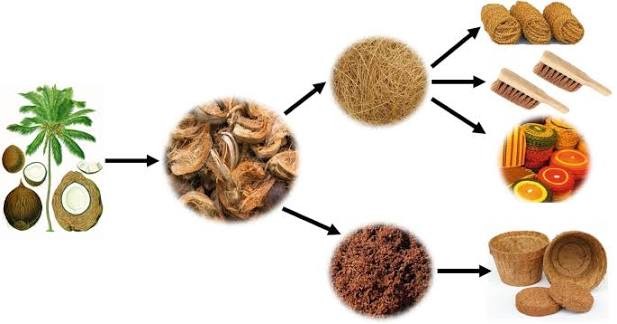
New Delh: What starts as coconut husk is becoming a source of income, entrepreneurship and local employment across India’s coconut-growing regions. Coir, a natural and durable fibre, is finding new uses in products ranging from mats and ropes to handicrafts, bio-fertilisers and eco-friendly packaging.
With support from the Ministry of Micro, Small & Medium Enterprises (MSME), particularly through the Coir Board and the Prime Minister’s Employment Generation Programme (PMEGP), traditional coir work is increasingly moving towards organised enterprises and value-added products.
In Kadiyam, East Godavari district of Andhra Pradesh, Allam Gowthamy turned coconut fibre and coir waste into an enterprise. After specialised training at the Coir Board Training Centre, Dhawaleswaram, she established Adigo Coir Products in 2024–25 with a project cost of Rs10 lakh.
The unit was supported by a Rs 6.50 lakh bank loan and PMEGP assistance. It now makes eco-friendly doormats, ropes, decorative dolls and handicrafts.
The enterprise has an annual turnover of around Rs 35 lakh and a profit of approximately Rs10 lakh. It directly employs six women.
Gowthamy has also trained nearly 120 women in coir mat weaving, rope making and handicraft production. Her enterprise has encouraged around five additional coir units in nearby areas with support from PMEGP.
In Kozhikode, Kerala, P. Surendran took a different route by turning coir pith into an agricultural input.
He established Sampoorna Plus Agro Fertilizer Enterprises (SAFE) in November 2024 after receiving training and technical support from the Coir Board, Kannur and the Central Coir Research Institute (CCRI), Kalavoor.
The enterprise produces coir pith bio-fertiliser designed to improve soil fertility and moisture retention.
Within a year, the unit built a customer base of more than 500, sold over 20 tonnes of bio-fertiliser and recorded a turnover of Rs 13 lakh, with a profit of Rs 4 lakh in FY 2024–25.
The unit employs five workers, including two women.
The journey shows how a material generated as a by-product of coconut processing can be converted into a product for sustainable agriculture and a source of rural employment.
Organised coir production in India began in 1859 with the establishment of the first coir factory in Alappuzha, Kerala. The sector has since expanded across major coconut-growing regions.
India is the world’s largest producer of coir and accounts for more than 80 per cent of global coir fibre production. Women account for nearly 80 per cent of people engaged in fibre extraction and spinning, making the sector particularly important for women’s livelihoods.
The coir value chain connects coconut farmers, workers, women artisans, cooperatives, entrepreneurs, manufacturers and exporters.
The sector’s potential lies increasingly in processing and value addition rather than simply producing raw fibre.
Coir is being used to make:
This shift towards finished products can create additional value and open opportunities for small rural enterprises.
The Coir Board, a statutory body under the Ministry of MSME, supports the sector through skill development, technology, research, market promotion, exports and welfare initiatives.
The Coir Vikas Yojana (CVY) covers areas including technology and research, skill development, women’s training, domestic and international market promotion, industry development and worker welfare.
Through training, technology adoption, product development and market access, these interventions aim to help people associated with the sector improve their skills and reach wider markets.
Exhibitions, fairs, showrooms and export promotion activities also provide coir producers with opportunities to showcase products and connect with customers.
Research is also expanding the possible uses of coir.
The Central Coir Research Institute has developed eco-friendly coir rail wheel axle packaging cups as an alternative to HDPE plastic cups. Such applications show how a traditional natural fibre can find a place in newer industrial and environmentally responsible products.
The stories of Allam Gowthamy and P. Surendran show two different ways in which coir can create economic value.
One uses coconut fibre to build a women-led handicraft and manufacturing enterprise. The other converts coir pith into a product for agriculture.
Together, they reflect a larger opportunity for the sector: using locally available resources, skills, finance, technology and market support to move from raw fibre to higher-value products and sustainable rural enterprises.